
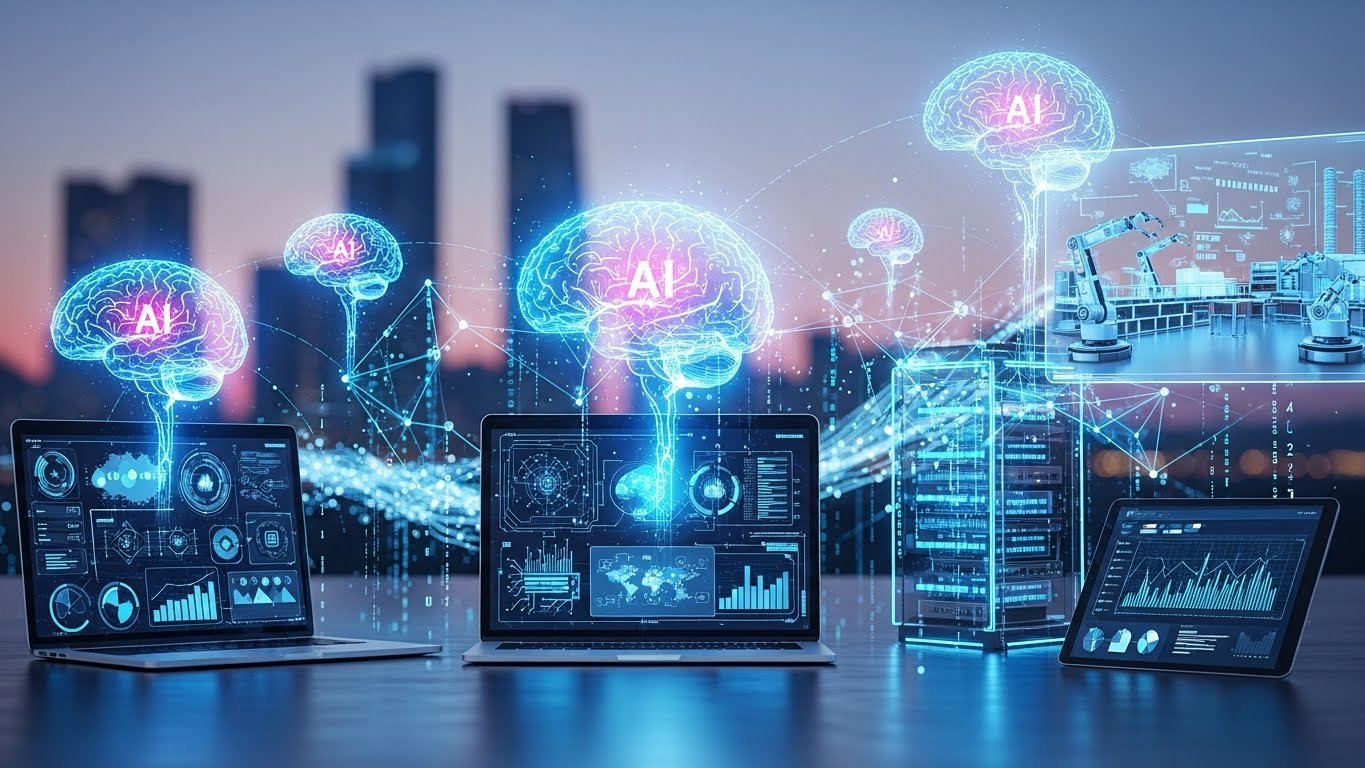
Mastering AI: 5 Ways AI Transforms Business Technology
Unlock AI’s profound potential! Discover how artificial intelligence is fundamentally reshaping business technology with 5 transformative strategies. Master AI for unprecedented innovation and a formidable competitive advantage in the modern enterprise.
Have you ever felt the exhilarating rush of adopting a groundbreaking technology, one that promises not just incremental improvements but a seismic shift in operational paradigms? That’s precisely the sensation permeating boardrooms and data centers across the globe today as organizations grapple with the profound query: How AI Is Reshaping Business Technology? The answer is complex, multifaceted, and undeniably revolutionary. From enhancing enterprise resource planning to fortifying cybersecurity protocols, the AI impact on business technology is nothing short of a paradigm shift, mandating a meticulous re-evaluation of established methodologies and strategic foresight.
1. Intelligent Automation and Operational Acuity: Elevating Efficiency Through AI Transformation Enterprise Tech
The first, and arguably most palpable, manifestation of AI’s transformative power within the corporate IT landscape lies in its capacity to imbue operational processes with unparalleled intelligence and automation. Beyond conventional Robotic Process Automation (RPA), which merely mimics human actions, AI-driven intelligent automation orchestrates a symphony of advanced algorithms, machine learning, and natural language processing to automate complex, cognitive tasks. This comprehensive AI transformation enterprise tech approach extends from back-office financial reconciliation to front-line customer service workflows, thereby eradicating bottlenecks and drastically reducing the incidence of human error.
Consider the realm of predictive maintenance in manufacturing or asset management. Legacy systems could flag issues post-occurrence; however, AI models, leveraging vast datasets from IoT sensors, can accurately forecast equipment failures before they materialize. This capability not only averts costly downtime but also optimizes maintenance schedules, extending asset lifespan and ensuring continuous operational uptime. The future of business technology AI is unequivocally intertwined with hyperautomation, where disparate tools are seamlessly integrated to achieve end-to-end automation, learning and adapting to dynamic business environments.
- Cognitive Process Automation: AI algorithms interpret unstructured data (e.g., emails, documents), making intelligent decisions beyond rule-based automation.
- Predictive Resource Allocation: Machine learning models analyze historical data to forecast resource needs, optimizing supply chain logistics and workforce management.
- Hyperautomation Frameworks: Integrating AI, ML, RPA, and process mining tools to achieve comprehensive automation across enterprise functions, minimizing human intervention.
Dynamic Workflow Optimization with AI
The real marvel of AI in automation isn’t just executing tasks, but dynamically optimizing entire workflows. Imagine a procurement process that not only automates invoice processing but also leverages AI to negotiate better terms with suppliers based on real-time market data and historical performance analytics. This level of sophistication transforms operational efficiency from a cost-reduction exercise into a strategic value-creation endeavor, solidifying the AI disrupting corporate IT narrative from the ground up.
Strategic Imperative: Process Mining with AI
Enterprises serious about leveraging AI for automation must first invest in AI-powered process mining tools. These platforms meticulously map and analyze existing workflows, identifying inefficiencies and automation opportunities that might otherwise remain opaque, laying the groundwork for successful AI integration.
Impact of AI on Operational Metrics
| Operational Metric | Pre-AI Benchmark | AI-Enhanced Performance |
|---|---|---|
| Processing Time (hr/task) | 2.5 | 0.3 |
| Error Rate (%) | 4.8 | 0.1 |
| Cost Reduction (%) | N/A | 25-40 |
“The true measure of artificial intelligence in enterprise operations is not just in what it automates, but in the intelligent elasticity and strategic agility it bestows upon an organization.”
2. Augmented Data Analytics and Prescriptive Intelligence: The Future of Business Technology AI
In an era drowning in data, the capacity to extract actionable insights and predictive intelligence is the cornerstone of competitive advantage. How AI is reshaping business technology in this domain is nothing short of revolutionary. Traditional business intelligence (BI) tools provide retrospective analysis, showing what has happened. Augmented analytics, powered by sophisticated machine learning algorithms, transcend this by providing not only descriptive and predictive insights but also prescriptive recommendations – telling businesses what should be done to achieve specific outcomes. This is the very essence of the future of business technology AI.
AI’s influence extends to democratizing data science, enabling business users without deep statistical expertise to uncover complex patterns and correlations. Natural Language Processing (NLP) interfaces allow users to pose questions in plain English, receiving sophisticated analytical responses and visualizations in return. Furthermore, AI-driven anomaly detection within vast datasets proactively identifies unusual patterns, safeguarding against fraudulent activities or highlighting nascent market trends long before human analysts could. The sheer volume and velocity of data generated by modern enterprises necessitate these advanced artificial intelligence business solutions to maintain relevance.
- Automated Insight Generation: AI autonomously identifies key trends, outliers, and correlations in data, presenting them in an easily digestible format.
- Prescriptive Modeling: Machine learning algorithms simulate various scenarios to recommend optimal strategies for sales, marketing, and operational efficiency.
- Real-time Data Stream Processing: AI enables instantaneous analysis of continuous data streams, critical for applications like algorithmic trading or dynamic pricing.
Democratizing Analytics with AI
One of the most profound impacts of AI transformation enterprise tech in analytics is the widespread accessibility of sophisticated data capabilities. Tools are emerging that allow non-technical personnel to perform complex analyses and generate predictive models through intuitive interfaces, lowering the barrier to entry for data-driven decision-making. This empowerment creates a more agile and responsive organizational culture, fostering innovation at every level. Forbes highlights this democratization as a key trend.
Caveat: Data Governance is Paramount
While AI augments analytics, its efficacy is directly proportional to the quality and ethical handling of input data. Robust data governance frameworks, including stringent data privacy and security protocols, are non-negotiable prerequisites for successful AI deployment in this domain.
3. Revolutionizing Customer Experience (CX) and Engagement: AI’s Impact on Business Technology Trends
The competitive landscape of today’s market is largely defined by the quality of customer experience. Here, how AI is reshaping business technology is particularly acute, offering enterprises unprecedented capabilities to personalize interactions, anticipate needs, and resolve issues with remarkable efficiency. AI-powered chatbots and virtual assistants have evolved far beyond rudimentary rule-based systems, now capable of understanding complex queries, expressing empathy, and even managing multi-turn conversations, thus elevating the standard for instant customer support.
Beyond immediate interactions, AI fuels hyper-personalization across the customer journey. Machine learning algorithms analyze vast quantities of customer data – purchase history, browsing behavior, social media sentiment – to deliver tailored product recommendations, personalized marketing campaigns, and content specifically curated to individual preferences. This proactive approach not only enhances customer satisfaction but also drives higher conversion rates and fosters brand loyalty. The shift from reactive service to predictive engagement epitomizes current business technology trends AI is driving.
- Personalized CX Journeys: AI algorithms craft unique customer paths, from initial contact to post-purchase support, optimizing touchpoints for maximum engagement.
- Sentiment Analysis: NLP models analyze customer feedback from various channels, providing real-time insights into customer mood and service gaps.
- Predictive Customer Service: AI identifies customers at risk of churn or those likely to need support, enabling proactive intervention and personalized offers.
The Evolution of Conversational AI
The sophistication of conversational AI, integral to customer experience, has reached a point where it can handle a significant portion of customer interactions without human intervention, reserving complex issues for human agents. This not only scales support capabilities but also allows human agents to focus on high-value, nuanced problem-solving. It’s a testament to the comprehensive AI transformation enterprise tech brings to customer-facing functions, moving beyond mere cost savings to genuine value addition.
“In the era of experience economy, AI is the invisible hand that tailors every interaction, making it feel uniquely human while operating at machine scale.”
4. Fortifying Cybersecurity and Risk Management: AI Disrupting Corporate IT Defenses
As the digital perimeter expands and cyber threats grow in sophistication, traditional rule-based security systems are proving increasingly inadequate. This is where AI disrupting corporate IT security becomes not just advantageous but imperative. AI and machine learning algorithms are uniquely positioned to analyze massive volumes of network traffic, user behavior, and threat intelligence data in real-time, identifying anomalous patterns that indicate a potential breach far more rapidly and accurately than human analysts ever could.
AI-powered cybersecurity solutions learn and adapt to new threats, evolving their defense mechanisms dynamically. They can differentiate between legitimate and malicious activity, prioritize alerts based on severity, and even automate response protocols, such as quarantining infected systems or blocking malicious IPs, thereby drastically reducing response times and mitigating potential damage. This proactive, intelligent defense mechanism is a critical component of modern AI impact on business technology, moving organizations from a reactive posture to a predictive and preventative one against ever-evolving cyber adversaries. IBM Research provides insights into AI’s future in security, underscoring its pivotal role.
- Behavioral Analytics: AI establishes baselines for normal user and system behavior, flagging deviations indicative of insider threats or compromised accounts.
- Threat Intelligence Synthesis: Machine learning aggregates and analyzes global threat data, providing predictive insights into emerging attack vectors.
- Automated Incident Response: AI orchestrates security tools to automatically contain and remediate threats, minimizing human intervention in critical moments.
Proactive Threat Hunting with AI
AI’s capabilities extend to proactive threat hunting, where algorithms actively search for vulnerabilities and potential points of exploitation within an organization’s IT infrastructure, mimicking attacker behavior. This offensive-defensive approach is transforming how enterprises secure their digital assets, a clear illustration of artificial intelligence business solutions providing advanced, defensive postures in a hostile digital environment.
Ethical AI in Security is Crucial
While AI bolsters security, ethical considerations regarding data privacy, bias in algorithms, and potential for misuse must be rigorously addressed. Transparent AI models and robust oversight are essential to build trust and ensure responsible AI deployment in cybersecurity.
5. Accelerating Innovation and Product Development: Business Technology Trends AI Is Spearheading
Perhaps the most exciting dimension of how AI is reshaping business technology lies in its profound ability to accelerate innovation and revolutionize product development cycles. Generative AI, for instance, is no longer confined to academic curiosities; it’s actively assisting engineers and designers in conceptualizing novel product designs, optimizing material usage, and even creating synthetic datasets for testing purposes. This drastically shortens the ideation phase, allowing for more iterations and robust validation before physical prototyping.
Beyond design, AI streamlines research and development (R&D) by rapidly sifting through vast scientific literature, patent databases, and experimental data to identify promising avenues for exploration or predict the efficacy of novel compounds. This is particularly transformative in fields like pharmaceuticals and material science, where drug discovery and advanced material development cycles can span decades. AI-powered simulation tools allow for virtual testing under myriad conditions, reducing the need for costly and time-consuming physical experiments. This forward-looking application solidifies AI’s role in defining the future of business technology AI, propelling industries into unprecedented realms of discovery.
- Generative Design: AI algorithms produce multiple design variations based on specified parameters, optimizing for performance, cost, or aesthetics.
- Accelerated R&D: Machine learning models identify correlations and patterns in complex scientific data, guiding experimental design and hypothesis generation.
- Personalized Product Roadmaps: AI analyzes market trends and customer feedback to inform product feature prioritization and future development strategies.
AI as a Creative Partner
The notion of AI as a creative partner is gaining traction, with algorithms assisting in everything from architectural design to musical composition. For businesses, this translates into unprecedented agility in responding to market demands and an ability to innovate at a pace previously unimaginable. This fundamental shift underscores how AI transformation enterprise tech is not just about efficiency but about expanding the very boundaries of human ingenuity within the corporate sphere.
“AI doesn’t just automate tasks; it catalyzes creativity, offering a new dimension to how we conceive, design, and bring innovations to life.”
Who Should Consider Mastering AI’s Transformative Power?
Embracing and mastering AI is no longer optional; it is a strategic imperative for any entity aiming for longevity and leadership in the digital age. The breadth of AI impact on business technology demands attention from a diverse set of stakeholders.
- C-Suite Executives and Board Members: Why this is good for them – Understanding AI’s strategic implications is crucial for setting long-term vision, allocating resources, and making informed investment decisions to secure competitive advantage and mitigate future risks.
- IT Directors and Technology Strategists: Why this is good for them – They are responsible for architecting and implementing the AI infrastructure, integrating solutions, and ensuring robust data governance, making deep AI knowledge indispensable for effective execution.
- Product Development and R&D Leads: Why this is good for them – AI offers unprecedented tools for accelerating innovation, optimizing design, and personalizing product offerings, directly impacting market relevance and growth opportunities.
- Operations and Supply Chain Managers: Why this is good for them – AI-driven automation, predictive maintenance, and optimization tools can drastically enhance efficiency, reduce costs, and improve resilience across complex operational landscapes.
- Cybersecurity Professionals: Why this is good for them – With AI as the most potent defense against sophisticated cyber threats, mastering AI-powered security solutions is critical for protecting organizational assets and maintaining data integrity.