
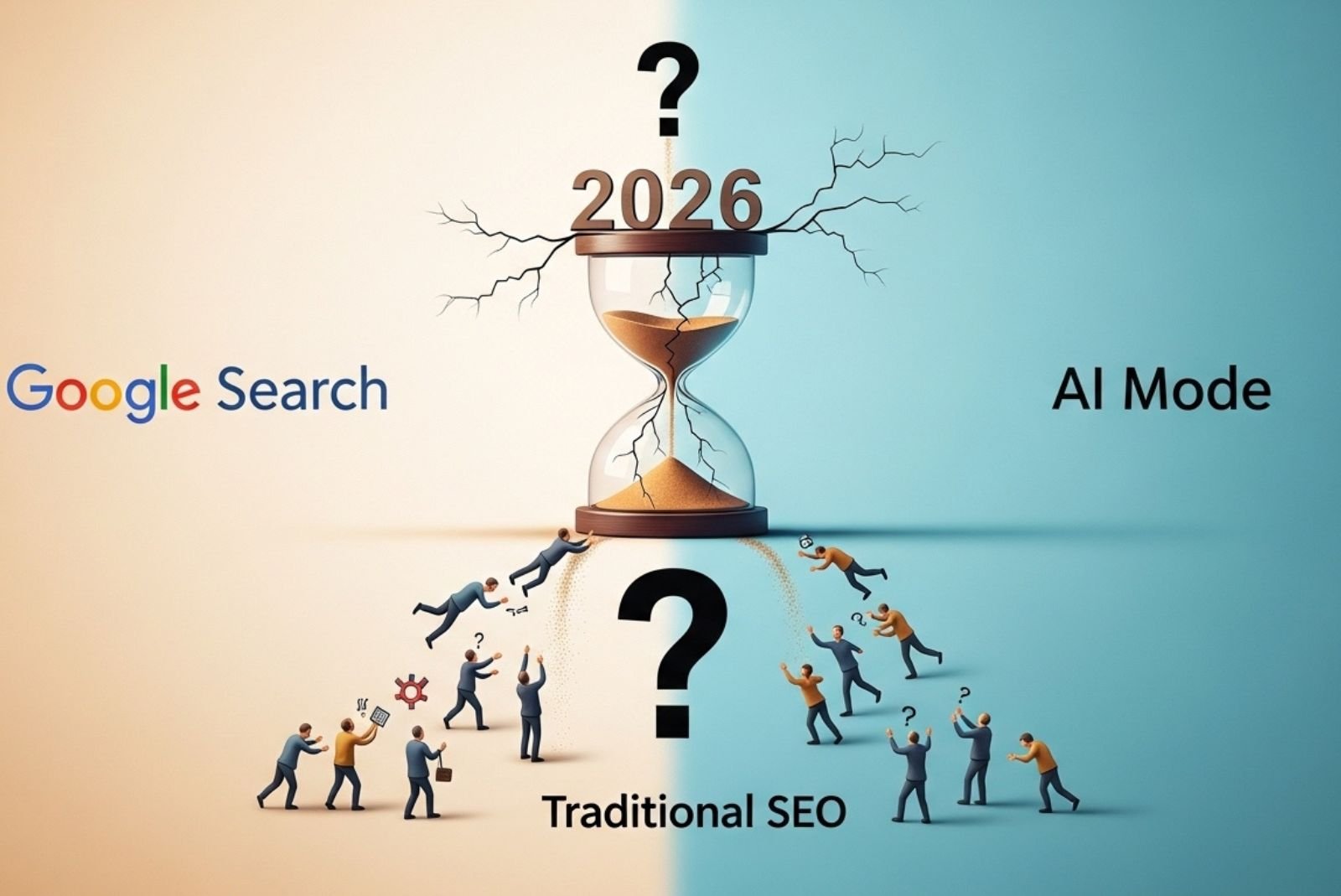
Traditional SEO’s Swan Song? AI Mode vs. Google Search Showdown.
Don’t get left behind! Is traditional SEO obsolete? Our comparison of AI Mode and Google Search reveals what you NEED to know to stay ahead.
Remember that unsettling feeling when the internet first started changing everything? Maybe it was social media popping up, or mobile devices taking over. Well, that familiar tingle of “what now?” is back, and it’s pointing squarely at how people find information online. We’re talking about the seismic shift happening in search, where AI isn’t just a helper, but a central player. If you’ve been wondering if all your hard work on traditional SEO is suddenly obsolete, or if you’re just feeling a bit lost in the noise, take a deep breath. You’re not alone, and we’re going to navigate this together.
The big question on everyone’s mind isn’t whether AI is coming it’s already here. The real challenge is understanding how AI-powered search modes are reshaping the landscape, and what that means for the strategies we’ve relied on for years. Is traditional SEO truly singing its swan song, or is it merely evolving into something more powerful, more nuanced? Let’s pull back the curtain and uncover the truth.
The Great Divide: Traditional Search vs. AI Mode
For decades, the standard Google search experience has been a predictable friend. You type a query, hit enter, and you’re presented with a list of blue links, maybe some ads, and a few snippets. Your job as a content creator or business owner was to get your link as high as possible on that list. This was the kingdom of keywords, backlinks, and technical wizardry.
Now, imagine a different scenario. You ask a complex question, and instead of a list of links, a sophisticated AI assistant gives you a direct, synthesized answer, drawing information from multiple sources. It might even offer follow-up questions or help you brainstorm ideas. This is the essence of AI Mode in search – a leap from an index of websites to an intelligent conversational partner. It’s like moving from a library catalog to a personal research assistant who’s read every book and can summarize exactly what you need.
💡 Quick Insight: AI Mode isn’t just a summary; it’s a *synthesis*. It combines information, checks for consensus, and often presents it in a way that feels complete, reducing the immediate need to click through to original sources. This fundamentally alters the user journey.
Why Traditional SEO Isn’t “Obsolete” (But It’s Definitely Different)
If AI is just giving direct answers, why bother with SEO at all? This is where the common misconception lies. Traditional SEO, in its purest form, isn’t dying; it’s transforming. Think of it like a caterpillar becoming a butterfly. The core principles are still there, but their manifestation and importance have shifted dramatically.
“The future of SEO isn’t about outsmarting AI; it’s about becoming indispensable to it. It’s about being the most trustworthy, authoritative, and helpful ingredient in its knowledge recipe.”
Here’s the thing: AI doesn’t conjure answers out of thin air. It learns from and synthesizes information that already exists online. This means that high-quality, authoritative, and well-structured content is *more critical than ever*. If your content isn’t robust enough for AI to understand, trust, and cite, you won’t even make it into the AI’s “knowledge recipe.”
So, instead of a swan song, let’s think of it as a remix. The foundational beats are still there, but the melody and instruments have changed.
Shifting Gears: Traditional vs. AI-Optimized SEO Focus
| Aspect of SEO | Traditional Focus | AI-Optimized Focus (The New Imperative) |
|---|---|---|
| Keyword Strategy | High volume, broad keywords; exact match targeting. | Deep understanding of user intent, semantic relatedness, long-tail *question-based* queries. Optimizing for conversational AI. |
| Content Creation | Getting pages to rank; often focused on length and keyword density. | Expertise, Experience, Authoritativeness, Trustworthiness (E-E-A-T) as the core. Comprehensive, uniquely insightful, factually robust, and clearly structured for AI consumption. |
| Technical SEO | Crawlability, indexability, site speed for human users. | Semantic clarity (Schema markup), flawless internal linking, lightning-fast Core Web Vitals. Making it effortless for AI to understand *what* your content is about and *who* created it. |
| Link Building | Quantity and domain authority. | Quality and contextual relevance from genuinely authoritative sources that AI trusts. Signals of *real* influence and credibility. |
| User Experience (UX) | Ease of navigation for human visitors. | Designing for both human *and* AI consumption. Clear headings, concise answers, interactive elements that deepen engagement *after* an AI summary. |
The New Battlegrounds: Where to Focus Your Energy
This isn’t about throwing out everything you know. It’s about a strategic pivot, focusing on areas that will make your content invaluable to both humans and AI.
Become the Authority AI Trusts: The E-E-A-T Imperative Squared
E-E-A-T (Experience, Expertise, Authoritativeness, Trustworthiness) has always been important, but now it’s the bedrock. AI is designed to prioritize credible, fact-checked information from known experts. If you don’t demonstrate genuine authority and experience in your niche, your content will likely be overlooked by AI in favor of more established, trusted sources. This means:
- Show, Don’t Just Tell: Back up claims with data, case studies, and personal experience.
- Author Bios Matter: Highlight the credentials and background of your content creators.
- Transparency is Key: Disclose sources, update information regularly, and correct errors swiftly.
Content for “Pre-Computation”: Structuring for AI Understanding
Imagine AI is doing its homework *before* a user even types a query. It’s pre-computing answers, understanding concepts, and mapping relationships between topics. Your content needs to be structured in a way that makes this easy.
- Clear, Concise Answers: Directly address questions in your content. Don’t bury the lead.
- Semantic HTML: Use headings (`h1`, `h2`, `h3`), lists (`ul`, `ol`), and paragraphs correctly to define structure.
- Schema Markup: This is your secret weapon. Using structured data helps AI understand the type of content you have (recipe, product, FAQ, how-to) and extract specific information with precision.
The “Human Hook”: Why They’ll Click Through from an AI Summary
Even if AI provides a comprehensive answer, there will always be a desire for deeper dives, unique perspectives, and human connection. This is your opportunity.
- Uniqueness and Personality: AI can’t replicate your authentic voice, your specific stories, or your individual take on a subject. Inject personality into your content.
- Interactive Elements: Quizzes, calculators, tools, videos, and dynamic charts offer an experience AI summaries can’t.
- Community and Engagement: Foster discussions, comments, and a sense of belonging around your content. This builds a loyal audience that will seek you out.
Niche Dominance and Hyper-Targeted Intent
Broad, general topics are prime candidates for AI summarization. But highly specific, nuanced, or truly niche topics? That’s where human-created, specialized content shines. Become the absolute authority on a micro-niche. AI will still pull from your site for those specifics, and users seeking that depth will find you.
💡 Pro Tip: Think of your content as a set of ingredients for a master chef (the AI). The better your ingredients (well-researched facts, clear explanations, unique insights), the better the final dish (the AI’s synthesized answer). And the more distinct your flavor, the more likely the chef will recommend your specific creation for those who want something special.
The Unsung Heroes: Technical SEO Gets Its Moment
While many talk about content strategy, the often-overlooked hero in the AI era is technical SEO. This isn’t just about search engine bots anymore; it’s about making your site machine-readable for advanced AI models.
Imagine a highly intelligent, but incredibly literal, robot trying to understand your website. If your site structure is messy, if there are broken links, if your content isn’t properly marked up, the robot will struggle. AI needs clean, accessible data. This means focusing on:
- Robust Internal Linking: Helps AI understand the hierarchy and relationships within your content.
- Canonicalization: Guiding AI to the definitive version of your content, preventing confusion.
- Mobile-First Indexing: Absolutely non-negotiable, as AI often prioritizes mobile-optimized content.
- Fast Loading Speeds: A seamless user experience is still paramount, and AI knows it.
Embracing the Evolution: Your Next Steps
So, is traditional SEO obsolete? Not at all. It’s evolving. It’s demanding more from us, pushing us to create content that isn’t just visible, but truly valuable, trustworthy, and deeply understood by both people and machines. It’s an exciting time, full of opportunities for those willing to adapt and innovate.
Instead of fearing the AI, let’s learn to dance with it. Let’s create content that elevates the entire web, becoming indispensable sources of truth and unique perspective. The future of online visibility isn’t just about keywords; it’s about becoming a trusted, intelligent partner in the global conversation. Let’s make sure your voice is heard, clearly and powerfully, in this new era.
Your Burning Questions, Answered: The AI Mode & SEO FAQ
What is “AI Mode” in search, really?
“AI Mode” refers to the integration of advanced artificial intelligence capabilities directly into search engines. Instead of just presenting a list of links, AI Mode aims to understand complex queries, synthesize information from multiple sources, and provide direct, conversational answers or generate new content based on user prompts. Think of it as having a highly intelligent research assistant built right into your search bar.
Will people stop clicking on search results if AI provides direct answers?
For simple, factual queries, some users may indeed be satisfied with AI-generated answers and not click through. However, for more complex topics, nuanced opinions, deeper dives, troubleshooting, or seeking unique perspectives and emotional connections, users will still want to visit original sources. The challenge for content creators is to provide that compelling “human hook” or specialized depth that encourages a click-through.
Is optimizing for AI different from optimizing for humans?
While there’s significant overlap (both benefit from quality, clarity, and relevance), there are distinct differences. Optimizing for AI involves a heavier emphasis on structured data (Schema markup), semantic clarity, explicit answers to questions, and ensuring content is easily digestible by machine learning models. Optimizing for humans additionally focuses on engagement, storytelling, visual appeal, and emotional resonance – elements AI might struggle to replicate or fully appreciate. The best strategy embraces both.
How important is E-E-A-T (Experience, Expertise, Authoritativeness, Trustworthiness) in the AI era?
E-E-A-T is no longer just a best practice; it’s fundamental. AI models are trained to prioritize highly credible, trustworthy sources to prevent the spread of misinformation. If your content lacks strong E-E-A-T signals – clear author credentials, robust citations, demonstrable experience – it’s far less likely to be selected by AI for summarization or direct answers, and consequently, less likely to rank well in traditional results either.
Should I stop focusing on keywords altogether?
No, don’t abandon keywords, but evolve your approach. Instead of just targeting exact match keywords, focus on understanding the underlying user intent behind queries. This means researching conversational phrases, long-tail questions, and topics related semantically. Keywords become indicators of intent, guiding your comprehensive content strategy rather than being the sole goal of individual pages.