
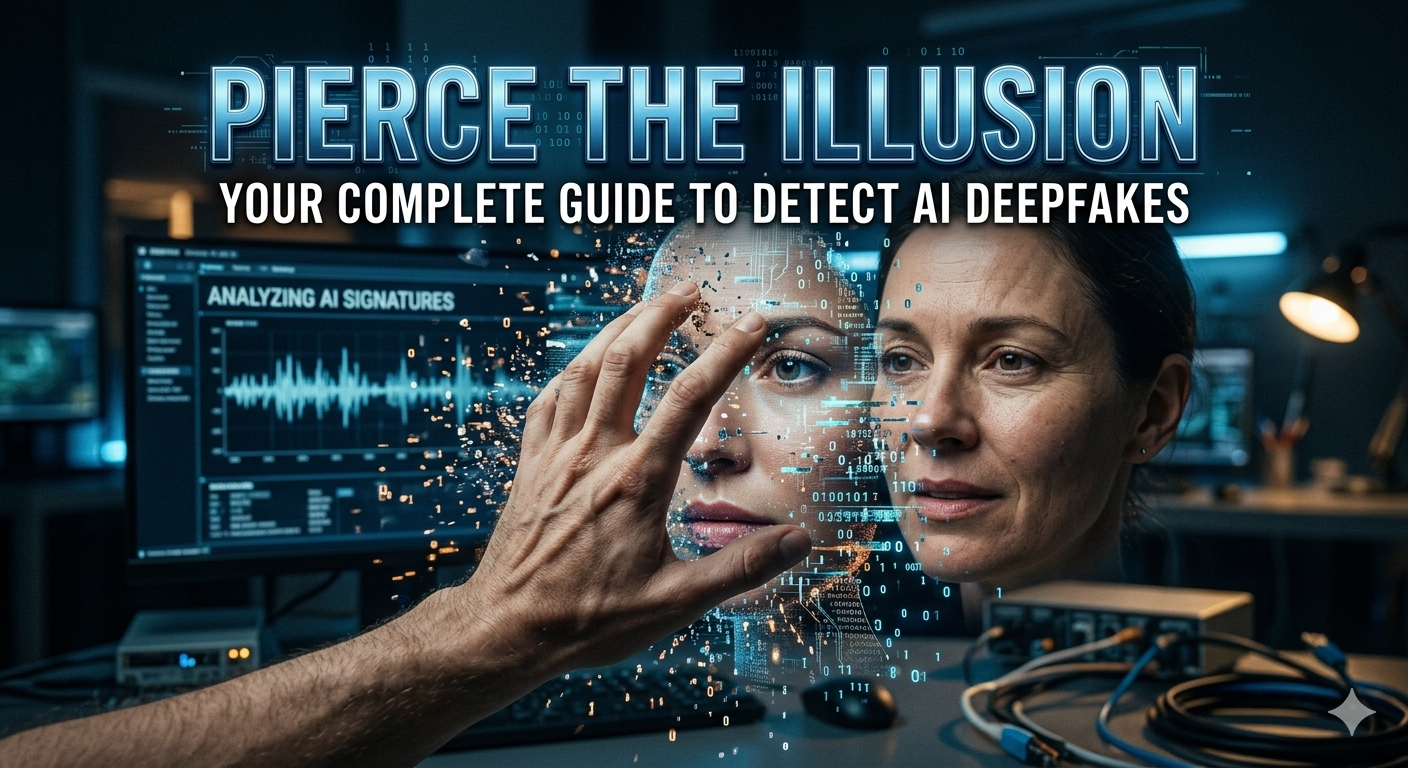
Pierce deception! Learn how to detect AI deepfakes with our complete, cutting-edge guide. Safeguard your reality against the latest digital forgeries. Don’t be fooled.
What if the very fabric of reality, as presented through your screens and speakers, is being meticulously rewoven by an unseen hand? This isn’t a hypothetical question anymore. It’s a daily challenge.
The digital landscape has fundamentally shifted. The line between what’s real and what’s synthesized has blurred to a point where traditional skepticism simply isn’t enough. We stand at a critical juncture where the power to discern truth from falsehood is not just a skill, but an absolute necessity for survival in the information age. This guide equips you with that power.
The Game Has Changed: Forget the jerky movements and pixelated edges of early deepfakes. Modern AI can generate faces, voices, and even entire scenarios with breathtaking, often undetectable, fidelity. The arms race between creation and detection is escalating, and you need to be on the winning side.
The Illusion Deepens: Why Old Tricks Fail
For too long, the advice on spotting deepfakes relied on obvious visual artifacts: flickering faces, mismatched skin tones, or peculiar eye movements. Those days are over. Sophisticated deepfake models have learned to iron out these imperfections, presenting a seamless, yet utterly fabricated, reality.
“The true danger of deepfakes isn’t the ability to create fakes, but the ability to erode trust in everything we see and hear. Our mission is to restore that trust, one discerning eye at a time.”
The key to modern detection lies in shifting our focus. We must move beyond surface-level glitches and dive into the subtle, often counter-intuitive, indicators that still betray AI’s fundamental limitations. It’s about finding the *unnatural perfection* or the *emotional void* that artificial intelligence still struggles to bridge.
The Pillars of Perception: Your Advanced Detection Toolkit
Detecting deepfakes now requires a multi-layered approach. No single red flag is definitive. Instead, we piece together a mosaic of clues, drawing from visual, auditory, behavioral, and even contextual analysis.
The Visual Deception: Beyond the Surface
While AI excels at rendering faces, it often falters at integrating them perfectly into a dynamic, complex world. This is where your trained eye becomes invaluable.
- The Micro-Expression Mismatch: Pay close attention to subtle facial cues. Does the emotion expressed truly match the context or the spoken words? AI often struggles with the nuanced dance of human emotion, particularly micro-expressions of surprise, fear, or genuine happiness. A smile might be perfect, but the eyes might not crinkle naturally, or the forehead might remain too smooth.
- Unnatural Blink Patterns: Humans blink irregularly, often around 15-20 times per minute, but with variability. Early deepfakes sometimes had a fixed blink rate or no blinking at all. Modern fakes have improved, but still watch for blinks that are too uniform, too infrequent, or occur at emotionally incongruous moments. The timing can feel “off.”
- Environmental Inconsistencies: This is a major tell. AI struggles with realistic reflections in eyes, glasses, or shiny surfaces. Look for strange light sources or shadows that don’t quite align with the scene’s primary lighting. Does the light reflecting in their eyes match the ambient lighting of the background? Often, it won’t. Are there reflections in a window that don’t match the scene in front of it?
- Hair and Ear Details: Hair, especially individual strands, remains a challenge for AI. Look for unnaturally smooth hair, or stray hairs that seem static or “painted on.” Earlobes, often overlooked, can sometimes show subtle distortions, strange textures, or an unnatural blending with the jawline.
- The Teeth Tell: While improved, AI sometimes generates teeth that are too perfect, unnaturally white, or have an odd alignment that doesn’t quite match the rest of the facial structure. Observe the uniformity or lack thereof in the deepfake’s dental work.
The Auditory Assault: Voices That Betray
Voice deepfakes are increasingly prevalent and convincing. However, they too have Achilles’ heels, particularly in the subtle textures of human speech.
- Tonal Monotony or Over-Expressiveness: Authentic human speech carries a natural variation in pitch, pace, and volume, reflecting emotion and emphasis. AI-generated voices can sometimes sound too flat, lacking natural inflection, or, conversely, overly dramatic with exaggerated emotional highs and lows that don’t feel genuine.
- Breathing and Mouth Sounds: Listen for natural breaths, pauses, and the subtle “lip smacks” or “clicks” that accompany human speech. AI voices often lack these natural imperfections, resulting in an unnaturally clean or seamless audio track. The absence of these cues can be as telling as their presence.
- Environmental Audio Consistency: Does the voice truly sound like it belongs in the environment depicted? If someone is speaking in a busy street, do you hear appropriate background noise and reverberation that matches their voice? AI often struggles to seamlessly integrate the synthesized voice with the ambient audio of a scene.
- Word Pronunciation and Emphasis: While AI can nail individual words, it sometimes struggles with the subtle emphasis and rhythm of phrases, especially in complex sentences or when conveying sarcasm or irony. Listen for words that are stressed unnaturally or a general “unflow” to the speech pattern.
The Behavioral Breach: Actions Speak Louder
This is arguably the most powerful, and often overlooked, detection layer. AI can mimic appearance and sound, but replicating the totality of human behavior, intent, and context is immensely difficult.
The Golden Rule: Context is King. Before you even scrutinize pixels or waveforms, ask yourself: Is this behavior consistent with what I know about this person? Does this statement make sense given their history, beliefs, or current circumstances?
- Out-of-Character Statements: If a public figure known for measured rhetoric suddenly launches into a vitriolic rant, or a friend makes a demand completely alien to their personality, a red flag should immediately go up. Deepfakes thrive on creating shocking content, often because shocking content gets shared without critical examination.
- Repetitive or Unnatural Gestures: AI models, when generating body language, can sometimes fall into repetitive loops or produce gestures that feel stiff, exaggerated, or simply don’t align with the spoken words. Observe hand movements, head nods, or even posture for subtle unnaturalness.
- Lack of Spontaneous Interaction: In a conversation, real humans react to each other, make eye contact, shift their gaze, and use fillers. Deepfake subjects, especially in generated conversations, may appear too focused, too static, or lack the nuanced back-and-forth of genuine human engagement.
- The Emotional Resonance Gap: This is a deep, psychological tell. Even when a deepfake visually and audibly *expresses* an emotion, does it *feel* real? Does it resonate with you as authentic human emotion? Often, there’s a subtle emptiness, a lack of genuine resonance, that a discerning observer can pick up on.
The Deepfake Detection Matrix: From Glitches to Ghosting
Common Deepfake Tells & What to Look For Now
| Category | Outdated Red Flags (Easily Fixed by AI) | Current Red Flags (AI Still Struggles) | The “Ghosting” Effect (Subtle AI Tells) |
|---|---|---|---|
| Visual | Flickering faces, pixelation, mismatched skin tones, unnatural eye color, lack of blinking. | Inconsistent reflections (eyes, glasses), odd earlobe geometry, static stray hairs, too-perfect teeth, unnatural shadow placement. | Micro-expression mismatch, lack of genuine eye crinkling during smiles, uniform blink rates, unnatural stillness in backgrounds. |
| Auditory | Robotic voice, obvious digital artifacts, monotone speech, strange pitch shifts. | Lack of natural breaths/mouth sounds, monotone delivery or over-expressiveness, poor integration with ambient sound, unnatural word emphasis. | Absence of subtle vocal imperfections, “too clean” audio, lack of emotional resonance in tone, inconsistent cadence. |
| Behavioral | Stiff body language, repetitive gestures, unnatural gaze. | Out-of-character statements, lack of spontaneous reactions, repetitive or stiff hand gestures, rigid head movements. | Emotional resonance gap (feels “empty”), inconsistent body language with speech, gaze that is too fixed or unnaturally wandering, lack of human “fillers” in speech. |
The Digital Fingerprint: Metadata and Forensics
While often requiring specialized tools, understanding the digital breadcrumbs can be crucial. Every digital file carries information.
- EXIF Data Anomalies: Image and video files often contain EXIF data (Exchangeable Image File Format), which provides details about the camera, date, and settings. Deepfakes may lack this data, have generic or conflicting information, or show inconsistencies when analyzed. This isn’t a silver bullet, but an important piece of the puzzle.
- Compression Artifacts and Codec Clues: AI-generated media often undergoes multiple layers of processing, which can leave unique compression artifacts or tell-tale signs of specific codecs used in their creation. While invisible to the naked eye, advanced forensic tools can sometimes detect these subtle digital fingerprints.
- Source Credibility and Tracing: Always question the origin. Where did this media first appear? Is the source reputable? Anonymously posted, highly inflammatory content should always be approached with maximum skepticism. Trace the content back to its earliest known posting if possible.
The Defender’s Mindset: Your Personal Shield
Ultimately, your greatest asset in this fight isn’t a piece of software, but a refined mindset. It’s about cultivating critical thought and a healthy skepticism.
“The greatest defense isn’t a tool, but a mind trained to question, to observe, and to cross-reference every piece of information that seeks to define your reality.”
Here’s how to build that mental fortress:
- Cultivate Extreme Skepticism: Treat any highly sensational, emotionally charged, or reputation-damaging content as potentially fabricated until proven otherwise. This isn’t cynicism; it’s self-preservation.
- Cross-Verification is Paramount: Never rely on a single source, especially for critical information. Seek corroboration from multiple, independent, and trusted news outlets or direct official channels.
- Zoom In, Slow Down, Listen Carefully: Don’t just glance. Take the time to pause, zoom into details, and listen to audio without visual distractions. Your brain processes faster than your conscious observation, giving you a chance to catch subtle discrepancies.
- Understand the Incentives: Who benefits from this deepfake being believed? What narrative does it push? Understanding the motivation behind a deepfake can often highlight its artificiality.
- Stay Informed: The technology evolves rapidly. Keep abreast of new deepfake capabilities and detection methodologies. Ignorance is no longer bliss; it’s vulnerability.
The Unseen Battlefield: Why This Matters More Than Ever
The proliferation of sophisticated deepfakes isn’t just an inconvenience; it’s a threat to democratic processes, individual reputations, and the very foundation of societal trust. From manipulating elections to blackmailing individuals, the potential for misuse is staggering. The ability to distinguish the authentic from the artificial is no longer optional; it’s a civic duty and a personal imperative.
When truth itself becomes malleable, manipulated by algorithms and disseminated at the speed of light, our collective ability to make informed decisions crumbles. This guide is more than a list of tips; it’s a manifesto for reclaiming our understanding of reality.
The future isn’t about eliminating deepfakes entirely; it’s about building a human firewall against their impact. The power to discern is now your most vital asset. Master these techniques, cultivate your critical eye, and become an unshakeable guardian of truth in a world increasingly filled with persuasive illusions. The illusion will always try to pierce your reality. Your job, now, is to pierce the illusion right back.